
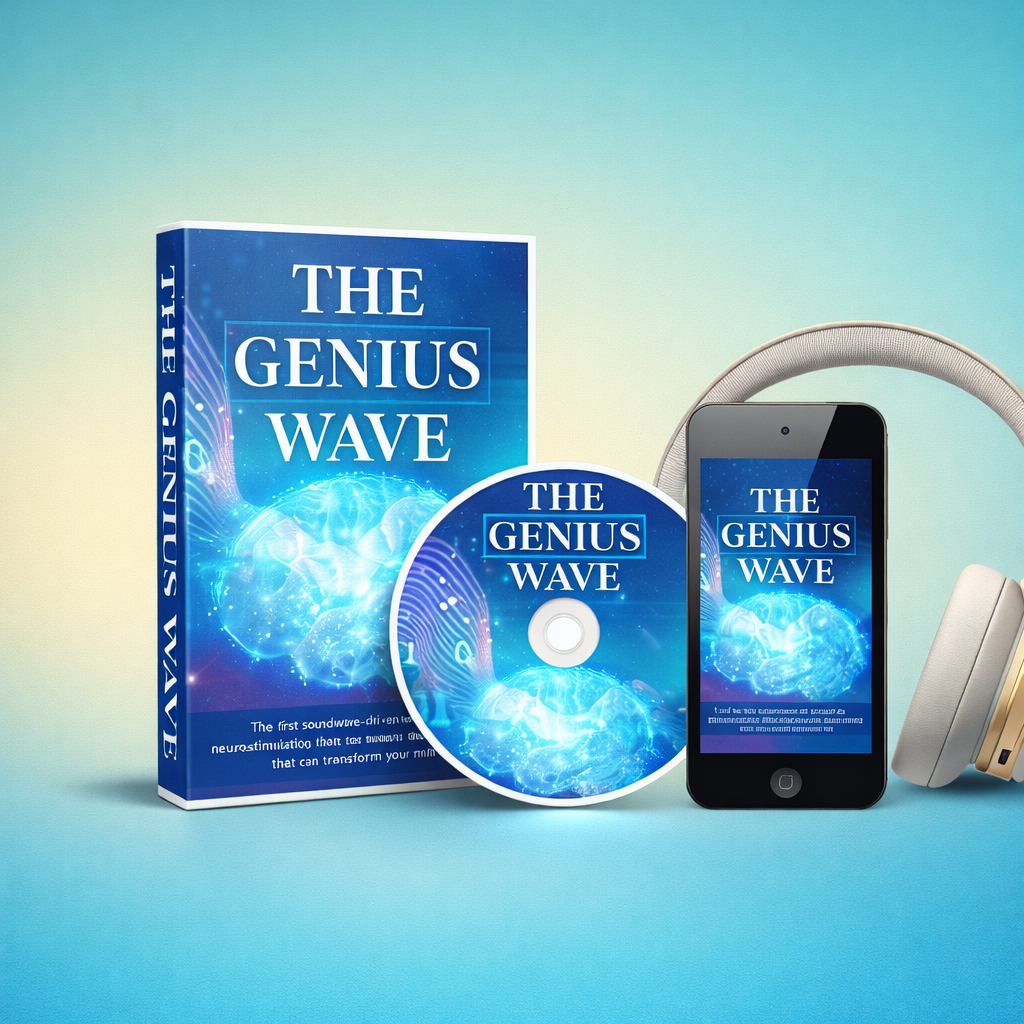
The Genius Wave Review: Benefits, Limits & Evidence
The Genius Wave is a digital audio program marketed around sound-based techniques intended to support relaxation, focus and mental clarity. If you are considering buying it, this independent review examines how the program is described, what the seller claims, what scientific evidence can and cannot establish, and which product details you should verify before purchasing.
We will also look at potential advantages, limitations, pricing and refund terms so you can make a more informed decision.
What Is The Genius Wave?

The Genius Wave is a digital audio program marketed as a sound-based approach to relaxation and mental focus. The seller describes it as a short listening session that uses binaural beats and isochronic tones, with the aim of influencing brainwave activity associated with relaxed mental states. Rather than requiring a physical device or supplement, the product is presented as an audio experience.
What Do You Get With The Genius Wave?
The seller’s currently indexed sales page describes The Genius Wave as a seven-minute audio program and says it can be listened to through headphones or speakers. The product is promoted as a digital offering, although the exact access and download process should be confirmed on the checkout page for the specific offer being purchased.
The materials advertised alongside the product are less consistent. Some pages mention a core audio track and instructions, while other pages promote additional guides or bonus resources. These claims should not be treated as a guaranteed package unless the current checkout page explicitly lists them.
The main points to understand before buying are:
Product format: A digital audio program, rather than a physical product.
Advertised session length: Seven minutes on the seller page reviewed for this article.
Intended use: Listening during a quiet break or as part of a relaxation or focus routine.
Additional materials: Guides, bonuses, access terms, and support arrangements require confirmation for the specific offer.
Evidence of effectiveness: The seller’s advertised benefits should be distinguished from results established through independent research.
What Is The Genius Wave Intended to Do?
The product is marketed around the idea that patterned sound may influence the brain’s electrical activity. Its promotional descriptions connect this approach with theta brainwaves, a frequency range commonly described in neuroscience as approximately 4–8 Hz.
Theta activity is a genuine subject of scientific study, but the association between a brainwave pattern and a particular mental state does not mean that deliberately listening to a recording will reliably produce that state or a specific benefit. Nor does the existence of research into sound stimulation establish that The Genius Wave itself has been shown to improve memory, intelligence, creativity, or productivity.
For prospective buyers, the most useful distinction is between the product’s intended purpose and its demonstrated effects. The audio may be appealing to someone looking for a convenient listening routine, but claims about measurable cognitive improvements require evidence from studies that test the actual product.
How Does The Genius Wave Audio Work?
The Genius Wave’s sales material describes its approach in terms of brainwave entrainment, binaural beats, and isochronic tones. These are related concepts in auditory research, but they are not interchangeable, and none should be interpreted as proof that a commercial recording produces all the results claimed for it.
1. Brainwave Entrainment: The Basic Idea
Brainwave entrainment is the idea that rhythmic external stimulation may influence the timing or pattern of neural activity. Researchers can investigate this by measuring electrical activity in the brain, commonly using electroencephalography (EEG), while participants listen to particular sounds or rhythms.
The principle is plausible enough to study, but the details matter. A measurable response to a sound does not necessarily demonstrate that the brain has entered a particular mental state, and a change in an EEG measurement does not automatically translate into better memory, stronger creativity, or improved problem-solving.
A 2023 systematic review of binaural-beat research found inconsistent evidence for the claim that these sounds reliably entrain brain oscillations. The studies differed in their audio parameters, experimental methods, and EEG measurements, making the overall findings difficult to interpret. This is evidence about the broader technique—not a direct test of The Genius Wave.
2. What Are Binaural Beats?
Binaural beats are an auditory perception that can occur when each ear receives a tone at a slightly different frequency. The auditory system can perceive a beat corresponding to the difference between the two tones.
For example, if one ear receives a 400 Hz tone and the other receives a 406 Hz tone, the perceived binaural beat is 6 Hz. This does not mean that either ear is receiving a separate 6 Hz sound; it is the perceived difference between the two tones.
Binaural beats are generally presented using headphones because the two ears need to receive their respective tones separately. Researchers have studied whether these beats affect relaxation, attention, mood, and brain activity, but results vary. The existence of the auditory effect alone does not establish a reliable cognitive benefit.
3. What Are Isochronic Tones?
Isochronic tones use regularly repeated pulses of sound, often with clear intervals between them. Unlike binaural beats, which depend on different tones being presented separately to each ear, isochronic tones can be heard as pulsing sound and do not inherently require headphones to create that pulse pattern.
These tones are also studied as a possible way to influence responses to rhythmic auditory stimulation. However, the evidence base is more limited for some specific applications, and the effects depend on the stimulus and the outcome being measured. It would therefore be premature to conclude that isochronic tones reliably produce a particular brain state or improve cognitive performance in everyday use.
4. Why Does The Genius Wave Mention Theta Waves?
Theta waves are a category of brain activity commonly described as occurring around 4–8 Hz. Theta activity appears in several contexts, including aspects of sleep, memory processing, and some forms of relaxation and meditation. Its meaning depends on where and how the activity is measured and what a person is doing.
The Genius Wave’s seller says its audio is designed to encourage activity in this frequency range. That is a description of the product’s proposed mechanism, not independent confirmation that listening to the recording reliably moves a listener into a theta state.
Even if a particular audio stimulus produces a measurable change in brain activity, further research would be needed to establish whether that change leads to a meaningful, repeatable improvement in a specific cognitive task.
5. What Does Scientific Research Actually Tell Us?
There is scientific literature on binaural beats, rhythmic auditory stimulation, and related brainwave-entrainment concepts. Some studies report changes in brain activity or psychological outcomes, while others find inconsistent or limited effects. Researchers continue to examine which stimulation methods work, under what conditions, and for which outcomes.
The important limitation is that research on a general technique is not the same as a controlled study of a particular branded recording. To establish that The Genius Wave improves memory, creativity, IQ, or other cognitive outcomes, researchers would need to test the actual product using appropriate comparison groups, predefined outcome measures, and transparent methods.
I could not verify a published, independent, peer-reviewed controlled trial testing The Genius Wave’s specific audio track and establishing those advertised cognitive benefits. That does not prove the product cannot provide a pleasant or relaxing listening experience; it means that stronger product-specific claims remain unestablished on the evidence reviewed.
What Should You Expect as a Listener?
A reasonable expectation is that The Genius Wave provides an audio track intended for a short listening routine. You may find the sound relaxing or useful as a cue to pause and settle into a task, but individual experiences can vary. Such an experience would not, by itself, demonstrate brainwave entrainment or prove an improvement in cognitive performance.
If you are considering purchasing it, check the current offer for the exact session length, playback and download instructions, included materials, and refund conditions. Treat claims about enhanced intelligence, memory, or creativity cautiously unless they are supported by reliable evidence testing this specific product.
Facts that still require verification before publication
Session duration: Seven minutes is stated on the seller page reviewed, but other pages using the product name have conflicting descriptions. Confirm the length of the actual audio supplied after purchase.
Delivery and access: Confirm whether the current offer provides a downloadable audio file, online playback, or both.
Listening instructions: The seller describes headphones or speakers, but headphones are particularly relevant if the recording uses true binaural beats. Verify the instructions accompanying the actual file.
Included materials: Confirm any guide, bonus audio, support, or lifetime-access claims on the specific checkout page; these vary across promotional pages.
Product-specific research: Ask the seller for published controlled studies that test the actual recording and its claimed outcomes. General studies of binaural beats are not sufficient.
Creator credentials: Do not repeat claims about the creator’s neuroscience or NASA background unless they can be independently verified through reliable biographical or institutional sources.
The Science Behind The Genius Wave: What Is Known and What Remains Uncertain
The Genius Wave is marketed as a short audio program that combines binaural beats and isochronic tones to encourage brain activity in the theta frequency range. Its sales page associates this approach with relaxation, focus, creativity and improved mental performance. These are claims made by the seller; determining whether they are scientifically justified requires examining independent research rather than relying on the product’s marketing language.
The central finding: Auditory stimulation can produce measurable responses in the human auditory system, and researchers have investigated possible effects on attention, memory and relaxation. However, results vary across studies. I could not verify a published, independent, peer-reviewed controlled trial demonstrating that The Genius Wave’s specific recording produces its advertised cognitive benefits.
1. What does brainwave entrainment mean?
Brain activity includes rhythmic electrical patterns that researchers measure using techniques such as electroencephalography (EEG). These patterns are often described by frequency bands, including theta activity, commonly defined as approximately 4–8 Hz.
Binaural beats occur when slightly different tones are presented separately to the two ears, creating the perception of a beat corresponding to their frequency difference. Isochronic tones, by contrast, use regularly repeated sound pulses.
Brainwave entrainment is the hypothesis that rhythmic external stimulation can influence the timing or frequency of neural activity. Researchers investigate this hypothesis by measuring brain responses during or after auditory stimulation.
It is important to distinguish three different outcomes:
Auditory response: The brain processes a sound or produces a response synchronized with its rhythm.
Brainwave entrainment: Neural activity shows a meaningful relationship with the stimulus frequency under an appropriate scientific definition.
Functional benefit: The listener demonstrates a measurable improvement in a task, such as recalling information or sustaining attention.
Evidence for the first outcome does not automatically establish the second, and neither alone proves the third. This distinction is particularly important when evaluating commercial products that connect a target brainwave frequency with broad claims about intelligence, memory or creativity.
For a detailed review of this distinction, see Ingendoh, Posny and Heine’s 2023 systematic review in PLOS ONE.
2. What do the important studies show?
The following studies examine binaural beats or related auditory stimulation—not The Genius Wave itself.
Study 1: Brainwave entrainment — Ingendoh et al. (2023)
Design: Systematic review of EEG studies examining whether binaural-beat stimulation produces changes in brain oscillatory activity consistent with entrainment.
Evidence base: Fourteen published studies, with individual study samples ranging from 4 to 47 participants.
Measured outcome: EEG indicators of brain activity during auditory stimulation, including frequency-related measures and other neural-response measures.
Findings: Five studies reported results consistent with the entrainment hypothesis, eight reported contradictory findings, and one produced mixed results.
Limitations: Studies differed in sound frequencies, presentation methods, duration, experimental design and EEG analysis. Many involved relatively small samples of healthy young adults. These differences make it difficult to compare results or determine a reliable, reproducible effect.
Relevance to The Genius Wave: This review directly challenges the assumption that playing a beat at a particular frequency reliably makes the brain oscillate at that frequency. It does not test The Genius Wave’s actual recording or establish whether it improves cognition.
Source: Ingendoh RM, Posny ES, Heine A. PLOS ONE (2023).
Study 2: Memory and attention — Garcia-Argibay et al. (2022)
Design: Systematic review and meta-analysis of research investigating binaural beats and memory- or attention-related outcomes.
Evidence base: Fifteen studies met the inclusion criteria, contributing 31 effect sizes.
Measured outcome: Performance on memory and attention tasks.
Findings: The authors reported an overall medium-sized statistically significant effect (Hedges’ (g = 0.40)). However, their review also identified conflicting results, particularly for theta- and beta-frequency stimulation across different memory and attention tasks.
Limitations: The included studies differed in stimulation frequencies, exposure schedules, tasks and participant characteristics. A pooled effect across heterogeneous experiments does not guarantee that a specific protocol works, and it does not establish a dependable benefit for every listener.
Relevance to The Genius Wave: This review provides some support for further research into binaural beats and cognition. It does not demonstrate that the commercial program improves memory, attention or intelligence, nor does it validate a seven-minute listening session.
Source: Garcia-Argibay et al. (2022), Psychological Research.
Study 3: Sustained attention — Robison et al. (2022)
Design: A series of experiments investigating 16 Hz beta-frequency binaural beats during sustained-attention tasks.
Sample size: The PubMed abstract reports three experiments but does not provide the total participant count in its summary.
Measured outcome: Reaction time, decline in vigilance over time, self-reported task engagement and pupillary indicators of arousal or engagement.
Findings: One experiment found a modest reaction-time difference, while another found a different pattern in vigilance decline. When the researchers combined results from the first two experiments, the evidence argued against a consistent improvement in sustained attention. The third experiment also found no evidence of an effect on the pupillary measures.
Limitations: The findings concern a particular beta-frequency stimulus and specific laboratory tasks. They cannot resolve every possible use of binaural beats, but the inconsistent results illustrate why positive findings from a single experiment should not be generalized broadly.
Relevance to The Genius Wave: The study does not test a theta-oriented commercial recording. It does, however, show that exposing listeners to a frequency associated with a brainwave band does not reliably improve a related cognitive function.
Source: Robison et al. (2022), Psychological Research.
Study 4: Relaxation and anxiety-related measures — Mallik and Russo (2022)
Design: Open-label randomized controlled trial comparing four sound conditions: music combined with auditory beat stimulation, music alone, auditory beat stimulation alone, and pink noise.
Sample size: 163 participants taking anxiolytic medication, allocated to four groups of 39, 36, 41 and 47 participants, respectively.
Measured outcome: Self-reported somatic and cognitive state anxiety, alongside measures of affect before and after one listening session.
Findings: Among participants classified as having moderate trait anxiety, music alone and music combined with auditory beat stimulation produced greater reductions in somatic anxiety than pink noise. The combined condition also produced greater reductions in cognitive anxiety than the other conditions. Results were less clearly differentiated among participants with high trait anxiety.
Limitations: The study was open-label, relied on self-reported outcomes and assessed a single 24-minute session. Participants were recruited from an online pool and were taking anxiolytic medication. The study cannot establish long-term effects or separate every possible influence of expectations and listening preferences.
Relevance to The Genius Wave: The study suggests that sound-based listening experiences may affect short-term subjective anxiety measures in some circumstances. It does not test The Genius Wave, and it does not establish that a seven-minute recording produces the same results. The differences between music and beat-only conditions also caution against attributing every observed benefit to brainwave entrainment.
Source: Mallik A, Russo FA. PLOS ONE (2022).
Study 5: Binaural beats as a stress-management tool — 2024 systematic review
Design: Systematic review of randomized controlled trials investigating binaural beats for non-clinical personal stress management.
Evidence base: Twelve studies.
Measured outcome: Stress-related outcomes, including self-reported responses following auditory stimulation.
Findings: Eight studies reported at least one statistically significant result favoring the intervention, while four found no group differences.
Limitations: The authors identified methodological heterogeneity, unclear randomization and blinding procedures, limited assessment of factors influencing outcomes, and insufficient knowledge about the best stimulation frequencies and schedules.
Relevance to The Genius Wave: This review supports cautious interest in binaural beats as a possible self-care listening format, but it does not establish a universal effect or validate a particular commercial product. It also does not justify presenting the program as a proven treatment for stress or anxiety.
Study 6: Theta-frequency binaural beats — 2026 systematic review and meta-analysis
Design: Systematic review and meta-analysis of randomized controlled trials examining theta-frequency binaural beats and outcomes involving pain, anxiety and cognition.
Evidence base: Thirteen randomized controlled trials with 630 participants. Four trials, involving 173 participants, could be pooled for pain outcomes.
Measured outcome: Pain-related outcomes, anxiety measures and cognitive outcomes.
Findings: The authors reported a reduction in pain compared with control conditions, but rated the evidence for this outcome as low certainty. Anxiety and cognitive outcomes could not be quantitatively pooled because of differences between studies. The authors described some promising cognitive findings, including findings related to episodic memory.
Limitations: The inability to pool anxiety and cognition outcomes limits the strength of conclusions for those areas. Low-certainty evidence for one outcome cannot be generalized to other outcomes or to all theta-frequency recordings.
Relevance to The Genius Wave: This recent review is a reason not to dismiss the entire field, but it is not evidence that The Genius Wave improves memory or mental performance. The trials examined different interventions and outcomes; their findings cannot be transferred to this commercial recording without direct testing.
Source: 2026 systematic review of theta binaural-beat interventions.
3. What does this mean for The Genius Wave’s claims?
The product’s sales page describes a seven-minute audio program using binaural beats and isochronic tones and associates it with relaxation, focus, creativity and improved mental performance. These are seller claims. The general research above does not independently confirm that the actual recording produces those results.
| Claim | What the evidence supports | Editorial assessment |
|---|---|---|
| The audio uses binaural beats and isochronic tones | The seller describes these techniques, but the recording has not been independently analyzed here. | Report as a seller-described feature, not a verified technical finding. |
| Audio can produce measurable neural responses | Auditory stimulation can produce measurable neural responses. | Scientifically plausible, but not proof of a desired mental state. |
| Theta-frequency audio reliably entrains theta activity | EEG findings are inconsistent across binaural-beat studies. | Not established as a reliable effect. |
| The program improves attention | Some studies report positive effects; others find no consistent improvement. | Unproven for this product. |
| The program improves memory or learning | Meta-analyses report some promising average effects, but findings vary. | Do not claim a proven benefit from this specific recording. |
| The program increases IQ or creativity | The reviewed evidence does not establish these outcomes for The Genius Wave. | Unsupported as a product-specific claim. |
| The program helps users relax | Some sound-based interventions have affected short-term self-reported measures. | A possible subjective experience, not a guaranteed or product-validated result. |
4. Why theta waves alone do not prove cognitive enhancement
Theta activity is a genuine and important subject in neuroscience. Researchers investigate its role in memory, navigation, sleep, attention and other processes. But a brainwave frequency is not a simple switch that turns on a particular ability.
The meaning of theta activity depends on the brain region, task, timing and method of measurement. Observing theta activity during a memory task does not prove that artificially stimulating a theta-frequency sound will improve memory. Similarly, a sound that produces a measurable neural response has not necessarily produced a beneficial change in thinking.
To substantiate a claim that The Genius Wave improves memory, for example, a suitable study would need to test the actual recording against a credible control, use validated memory measures, account for expectations and other confounders, and report the results transparently. Claims about IQ, creativity or sustained attention would require appropriate measurements for those outcomes as well.
5. What research would establish whether The Genius Wave works?
A persuasive product-specific evidence base would include:
Independent testing: Researchers with no material conflict of interest assess the actual recording.
A suitable control group: Participants are assigned to the product or a credible comparison condition, ideally with blinding where feasible.
Predefined outcomes: The study specifies whether it is testing relaxation, attention, memory or another distinct outcome.
Appropriate measurements: EEG is used if the claim concerns brainwave entrainment; validated behavioral tasks are used if the claim concerns cognitive performance.
Adequate sample size: The study is designed to detect meaningful effects rather than relying on a small exploratory sample.
Transparent reporting and replication: Methods, limitations, funding and conflicts of interest are disclosed, and findings can be independently reproduced.
I could not verify a published, independent, peer-reviewed controlled trial of The Genius Wave’s specific recording that establishes its advertised cognitive benefits. This is a statement about the evidence I could verify, not proof that no unpublished or otherwise inaccessible testing exists.
Conclusion: What Is Known and What Remains Uncertain?
Binaural beats and rhythmic auditory stimulation are legitimate subjects of scientific study. Some studies and meta-analyses report potentially beneficial effects on selected cognitive or psychological outcomes, while others find inconsistent or null results. Research into theta activity also does not demonstrate that deliberately listening to a theta-frequency recording will reliably improve a particular ability.
For The Genius Wave specifically, the advertised audio format and proposed mechanism can be described, but its stronger claims about memory, IQ, creativity and cognitive performance remain unverified by product-specific evidence identified for this review.
A reader may still enjoy the recording as a short audio routine or find it subjectively relaxing. That possibility should be described honestly, without converting personal preference or general scientific research into a promise of cognitive enhancement.
Editorial verdict: The underlying techniques merit continued research, but the available evidence is not sufficient to present The Genius Wave as a scientifically proven cognitive-enhancement program. Readers should evaluate it as an optional audio product, not as an established method for improving brain performance.
The Genius Wave: Price, What’s Included and Refund Policy
Before purchasing The Genius Wave, review the current offer carefully. The product is marketed as a digital audio program, but buyers should confirm the final price, exact audio supplied, access arrangements and refund terms at checkout.
The Genius Wave Buyer Information
| Purchase detail | Information available from the seller |
|---|---|
| Advertised price | $39 USD on the linked purchase page at the time of review. The sales page also displays a higher reference price of $149; treat that comparison price as a seller claim, not an independently verified usual selling price. |
| Payment frequency | The reviewed page displays a $39 offer but does not clearly establish whether any recurring charges apply. Check the final order summary before paying. |
| Main product | A digital audio program marketed around theta brain activity and sound-based stimulation. |
| Session duration | Inconsistent: the sales page says seven minutes, while its linked purchase page describes a 12-minute experience. Confirm the actual supplied recording. |
| Included digital materials | The linked purchase page describes the audio experience. A separate PDF guide, bonus materials or other extras could not be confirmed from that page. Do not assume they are included unless the final offer lists them. |
| Delivery method | The linked purchase page describes the product as digital and says buyers can begin right away. Confirm whether access is provided by download link, email or an online account. |
| Access period | The linked page says the digital copy is yours to keep. The precise download availability and any account or access restrictions are not fully explained in the material reviewed. |
| Refund guarantee | The linked purchase page advertises a 90-day money-back guarantee, with terms applying. Read the linked refund policy and confirm the eligibility conditions before ordering. |
| Product support | The purchase page provides a seller-support link, but that link did not resolve successfully during this review. The associated sales website lists info@binauraltechnologies.com; verify that this contact route is active before relying on it. |
| Order support | The purchase page directs order-related questions to ClickBank Customer Service. Keep your order confirmation and transaction details. |
Sources: seller’s sales page and linked purchase page. The purchase page also links to its own returns and refund information. These pages describe the offer; they do not independently verify product quality or effectiveness.
What to Check Before Paying
Before completing your order, confirm these points on the live checkout page:
The total amount charged and the currency.
Whether the payment is one-time or recurring.
The exact audio duration and the digital materials included.
How the product will be delivered and how long access remains available.
The refund deadline, eligibility requirements and procedure.
A working seller-support contact.
The seller’s published terms and promotional offers may change. Save a copy of the checkout summary, refund terms and purchase confirmation for your records.
Check the Current The Genius Wave Offer
If you are interested in the audio format, review the seller’s current offer and make your decision based on the final price, confirmed inclusions and refund conditions—not solely on promotional claims about memory, creativity or mental performance.
Disclosure: This page may contain an affiliate link. If you purchase through it, we may earn a commission at no additional cost to you. We recommend reviewing the terms directly before making a purchase.
The Genius Wave Review: Frequently Asked Questions
What is the Genius Wave?
The Genius Wave is a digital audio product marketed as a brainwave-entrainment tool. The seller says it uses binaural beats and isochronic tones to encourage theta-range brain activity. It promotes the recording as a simple listening routine for people interested in relaxation, focus, and creativity.
These are the seller’s stated aims, not proof that the product produces measurable improvements in memory, intelligence, or productivity.
How long is a Genius Wave session?
The advertised duration is inconsistent. The Genius Wave sales page describes a 7-minute session, while the linked purchase page describes a 12-minute audio experience. Buyers should check the exact product description and delivered file before assuming which version is included.
This discrepancy is worth resolving with the seller before purchase.
What comes with The Genius Wave?
The main offer is described as a digital audio program. The seller’s sales page also lists a PDF guide, quick-start bonus materials, and personal support. However, the linked purchase page does not clearly confirm every bonus listed on the sales page.
Review the current checkout details and order confirmation to establish exactly which files and extras are included. Do not assume that every advertised bonus is part of every offer.
Is The Genius Wave scientifically proven to work?
There is no product-specific scientific evidence verified for this review that establishes The Genius Wave’s advertised cognitive benefits. Research into binaural beats and brainwave entrainment more broadly is mixed.
A 2023 systematic review in PLOS ONE examined 14 studies of binaural-beat stimulation and brain activity. Five studies supported the entrainment hypothesis, eight reported contradictory findings, and one reported mixed results. The researchers highlighted substantial differences between study methods, making firm conclusions difficult.
That research concerns binaural beats generally; it does not demonstrate that The Genius Wave itself improves memory, intelligence, creativity, or concentration.
Research source: Ingendoh et al., 2023, PLOS ONE.
How much does The Genius Wave cost?
At the time of this review, the linked purchase page displayed a price of $39 USD. The seller’s page also displays a higher comparison price, but that should not be treated as proof of the product’s usual market value.
Prices and promotions can change. Confirm the amount shown on the final checkout page before paying, and check for any additional items or charges.
Is The Genius Wave delivered digitally?
Yes. The linked purchase page describes the product as digitally delivered and says buyers can begin using it right away. It also says the digital copy is yours to keep.
The page does not fully explain every aspect of file access or delivery. Check the checkout and order confirmation for instructions on how to receive the audio, whether an account is required, and how to retrieve it later.
Does The Genius Wave offer a money-back guarantee?
The linked purchase page advertises a 90-day money-back guarantee, subject to terms. The seller’s sales page also promotes a 90-day promise.
Before buying, read the current refund terms and confirm the process, eligibility requirements, and deadline. Keep your order confirmation and receipt. If the policy wording is unclear or inconsistent, ask the seller or ClickBank order support to clarify it before relying on the guarantee.
How is The Genius Wave different from free binaural-beat audio?
The main difference is that The Genius Wave is a paid, branded product, while free audio tracks are available through various apps and websites. The paid offer may include a packaged listening experience and supplementary materials, depending on the current offer.
However, a price tag or branded presentation does not establish that the audio is more effective than free alternatives. If your goal is simply to explore ambient audio or binaural beats for relaxation, a free track may be enough to see whether you enjoy this type of listening.
Compare the actual features, listening experience, access terms, and cost rather than assuming a paid recording delivers better results.
What are the limitations of The Genius Wave?
The most important limitation is the gap between the seller’s broad claims and the product-specific evidence available to verify them. The research reviewed here does not establish that this particular recording reliably increases intelligence, improves long-term memory, or produces lasting cognitive changes.
Other considerations include the conflicting advertised session length, unclear confirmation of all bonus materials, and the need to check current refund and access terms. Personal experiences can differ, and testimonials are not a substitute for controlled scientific research.
Treat the audio as an optional listening product, not as a proven treatment or a guaranteed way to improve cognitive performance.
However, a price tag or branded presentation does not establish that the audio is more effective than free alternatives. If your goal is simply to explore ambient audio or binaural beats for relaxation, a free track may be enough to see whether you enjoy this type of listening.
Compare the actual features, listening experience, access terms, and cost rather than assuming a paid recording delivers better results.
Where can I verify the current offer?
Start with the The Genius Wave sales page and follow its purchase link to the linked purchase page. Check the final checkout screen for the price, product description, payment details, and any optional add-ons. Read the current terms and refund policy before completing the order.
The seller’s pages currently differ on session duration, so ask the seller to confirm which version will be delivered if that detail matters to you. The linked purchase page directs product questions to seller support and order questions to ClickBank.
Other considerations include the conflicting advertised session length, unclear confirmation of all bonus materials, and the need to check current refund and access terms. Personal experiences can differ, and testimonials are not a substitute for controlled scientific research.
Treat the audio as an optional listening product, not as a proven treatment or a guaranteed way to improve cognitive performance.
However, a price tag or branded presentation does not establish that the audio is more effective than free alternatives. If your goal is simply to explore ambient audio or binaural beats for relaxation, a free track may be enough to see whether you enjoy this type of listening.
Compare the actual features, listening experience, access terms, and cost rather than assuming a paid recording delivers better results.
Is The Genius Wave worth trying?
That depends on your expectations. If you are curious about audio-based relaxation and are comfortable paying for a packaged digital recording, you may decide it is worth considering. If you expect proven improvements in intelligence, memory, or work performance, the available product-specific evidence does not justify that expectation.
Bottom line: The Genius Wave is marketed as a short digital audio program, but its session length is inconsistently described and its claimed cognitive benefits have not been established by product-specific evidence verified for this review. Check the current offer and refund terms carefully, compare it with free alternatives, and make your decision based on the features you can confirm—not on promises of transformation.
All content and information found on this page are for informational purposes only and are not intended to diagnose, treat, cure or prevent any disease. The FDA hasn’t evaluated the statements provided on this page. Make sure you consult with a licensed doctor before taking any supplement or making any changes to your diet or exercise plan. Individual results may vary.
The display of third-party trademarks and trade names on this site does not necessarily indicate any affiliation or endorsements of our website. If you click a merchant link and buy a product or service on their website, we may be paid a fee by the merchant.
Affiliate disclosure: This review may contain affiliate links. If you purchase through a qualifying link, the publisher may earn a commission at no additional cost to you. The commission does not establish product effectiveness and should not affect your assessment of the evidence.
Privacy Policy | Disclaimer | Terms & Conditions | Refund Policy
© Copyright 2026 Last Update Oct 2026
is proudly powered by WordPress